Sales support for IT companies
Lead Generation for Mobile App Development Companies
UpGrowthDesk helps app development companies organise buyer research, proposals and follow-up around the platforms and delivery work they can prove. Your team keeps control of estimates, technical commitments and client decisions.
By Abhishek Bhambhana · Reviewed 18 Nov 2026
Define which part of the app you deliver
An app enquiry can hide several different projects. A buyer may need a native iOS application, a cross-platform interface, an existing app repaired, a backend connected, or help preparing a release. These require different experience. Before looking for leads, describe the platforms and stages your team can own, including any backend, design, testing or release work that sits outside your scope.
We use that definition to shape the search and messages. A strong React team should not be described as having native mobile release experience unless it does. A backend-only team may still fit an app project when responsibilities are clearly separated. The objective is to find a workable match between the buyer's requirement and your actual delivery capability.
Give buyers evidence they can inspect
For app work, a relevant example should explain the platform, your role and the state of the product. A live store listing, a permitted demonstration or an approved walkthrough can help, but each proves something different. A store listing establishes that an app is available; it does not explain which features your team built or whether you handled the release.
Prepare concise notes about the difficult parts you owned, such as authentication, offline behaviour, device permissions, integrations or maintenance of an existing codebase. Use only work you are allowed to disclose. Avoid claiming user growth, retention or commercial success from an interface screenshot. When your evidence is a prototype or personal project, label it clearly so a buyer can assess it on the right basis.
Separate an app idea from a ready project
Some buyers arrive with an idea and no agreed user flow. Others have designs, an API and a defined release target. The first conversation should establish which situation applies. Ask who the users are, what the first useful version must do, which platforms matter and what already exists. A long feature list is not necessarily a complete specification.
For research and qualification, we look for those distinctions rather than treating every app request as equivalent. Your team can set a minimum workable scope and identify when discovery is required. This helps avoid quoting a full production build from a few screens. It also makes the next step easier to explain: validate a critical flow, inspect an existing repository, or agree the first milestone before committing to the whole product.
Research opportunities across three channels
On Upwork, we inspect the requested platform and the central delivery need. A listing that mentions Flutter may still be mainly about backend integration, and a listing that mentions an API may still require a full mobile team. The proposal needs to address the real requirement and show matching evidence. Your team reviews important claims and the proposed scope through the agreed process.
For LinkedIn and email, we research relevant companies and decision makers using public context. A product announcement or an existing app can inform a thoughtful question, but we do not invent a performance problem to create a sales pitch. We agree the target audience, message approach and sending responsibilities before outreach. The first message should make it clear why your particular capability may be relevant.
Inspect the app-project record we can substantiate
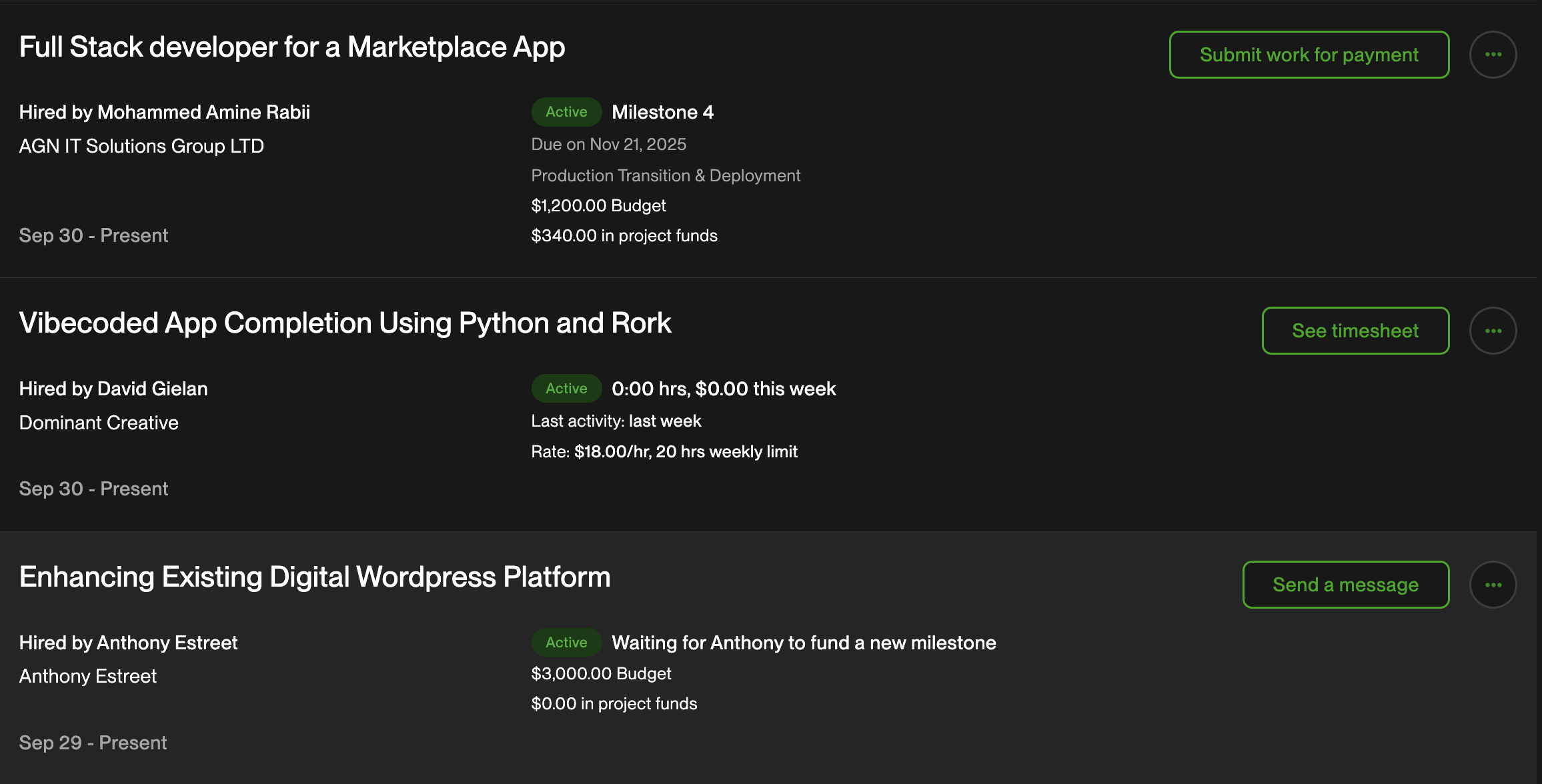
Our archived September account view lists “Vibecoded App Completion Using Python and Rork.” The saved row is marked active and shows an $18/hour rate with a 20-hour weekly limit. You can open the original screenshot from our Proof page and inspect the account labels.
This is evidence of an app-related contract record from account work Abhishek says he supported. It does not establish native iOS or Android delivery, store approval, completed hours, revenue, or the effect of a particular outreach campaign. We do not present it as a native-mobile case study.
For a mobile agency considering our service, the relevant principle is to preserve that distinction in your own sales material. An app-related project can support a specific claim about the work shown. Broader claims about platform delivery or business results need their own evidence.
Use discovery to expose release dependencies
Before an app estimate is final, clarify who controls the store accounts, signing credentials, backend services, test data and design decisions. Ask which devices and operating-system versions matter, whether the app uses sensitive information, and who will review the release. Your technical team should determine which requirements affect the architecture, testing and schedule.
An educational buyer scenario is a team asked to “finish an app” when the interface exists but the API and release responsibilities are unclear. The useful response is to inspect the current state and define those boundaries before quoting completion. This is a planning example, not a UGD client result. It illustrates why a sales process needs technical qualification rather than a quick promise based on the word “app.”
Track the buying decision through handoff
We help prepare follow-up around the unresolved decision. A buyer may need to confirm the first release scope, supply a repository, choose a platform, or obtain internal approval. Each opportunity should have a clear next action and owner. A booked call alone is not a delivery-ready project, and a promising discussion should not be counted as a signed contract.
The working report should also capture fit feedback from your team. If prospects repeatedly need a platform you do not support, revise the research criteria. If a common concern is maintenance after launch, explain your actual maintenance arrangement earlier. We refine the process from the conversations and evidence available, while your team remains responsible for estimates, technical decisions, release commitments and delivery.
Request a quote for the support you need
Mobile-app company sales support uses a custom scope and quote. We agree the platforms and services being promoted, target buyers, channels, research depth, writing and follow-up responsibilities, and reporting rhythm. The pricing page explains the available service structure; a published Upwork management tier is not automatically a price for a broader mobile-agency campaign.
To begin, share the app work your team wants more of and the evidence you may show. Include your capacity, target project size, supported platforms and any work you do not want to take on. We can then prepare a focused first-cycle plan. A useful start is a clear offer and a small researched set of opportunities that your delivery lead can assess, followed by messages approved through the agreed workflow.
Questions before you start
Can you find native iOS and Android projects?
We can research those requirements when your team has the relevant capability and evidence. We define the exact platforms and delivery boundaries before preparing proposals.
Does the public app screenshot prove a native-mobile result?
No. It records an app-completion contract using Python and Rork. It does not verify native mobile delivery, store submission or campaign results.
Can you promise an app project within a fixed time?
No individual buyer decision or project award can be promised. We agree the research, writing, follow-up and reporting work and keep the pipeline visible.
Choose the support and prepare the next step
Plan a useful first client call · See pricing and request a custom quote
Source records
Bring the work you want to win.
Share your offer, evidence and delivery capacity. We will agree the scope and a custom quote before starting.
Discuss your sales process ↗